
How to Open a School in Pakistan: The 2026 Guide

Pakistan still has around 20 million children between the ages of 5 and 16 who are not in school. That number comes from the Household Integrated Economic Survey (HIES) 2024–25, released by the Pakistan Bureau of Statistics in January 2026. It is the most current official figure available.

The government spends just 0.8% of GDP on education — a record low, according to the Pakistan Economic Survey 2024–25. UNESCO recommends 4–6%. The gap between what the state provides and what families need has never been wider. That gap is where private schools operate. And it is growing.

If you have been thinking about opening a school in Pakistan — whether as an investment, a community service, or both — this guide explains exactly what is involved.

Two Ways to Do It

There are only two paths to opening a school in Pakistan.

Start from scratch

You build everything yourself: brand, curriculum, admissions process, teacher training, administrative systems, parent trust. Most independent schools take 3–5 years to reach financial stability. Many do not get there at all.

Join a franchise

You invest in a proven model — brand, curriculum, systems, and support already built. You still run the school. You still need a property, staff, and genuine commitment. But you are not starting from zero.

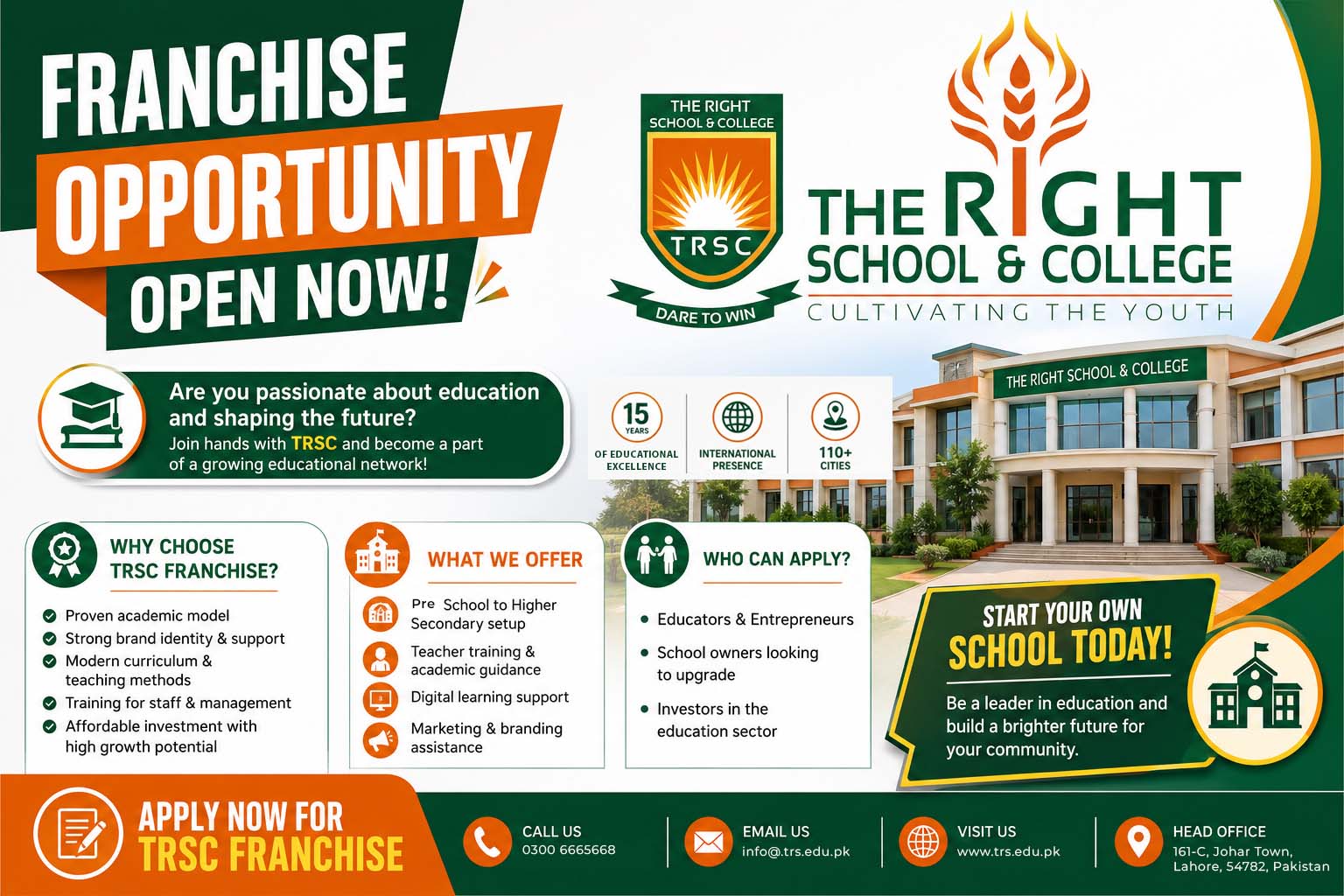
The Right School and College (TRSC) has operated since 2011. It now runs 104 campuses across Pakistan and international branches in Libya. Every year TRSC has learned what makes a school succeed — and what makes it fail. That knowledge comes with a TRSC franchise.

Why a School Beats Most Other Investments

Three reasons schools are uniquely resilient in Pakistan’s economic environment:

Demand does not fall during inflation

When household budgets tighten, education spending is the last to be cut — not the first. Private school enrolment in Pakistan has grown consistently even through the inflation cycle of 2022–2025.

Pakistan’s private school market is growing

According to the Pakistan Education Statistics Report 2022–23 (PIE), total educational institutions grew by 12% in a single year — from 313,445 to 349,909. Private schools now account for approximately 34% of all primary enrolment, per World Bank data. Families across income levels are choosing private over government wherever they can afford it.

The enrolment funnel creates permanent demand

Pakistan’s total school enrolment stands at 58.3 million (Pakistan Education Statistics 2023–24). Of every 100 children who start primary school, only about 23 reach matriculation level, according to UNICEF Punjab Education Fact Sheets. Every dropout cohort represents a new generation of parents who want something better for their own children — and are willing to pay for it.
 

Benefits of Opening a School in Pakistan in 2026 | TRSC Franchise

Every morning across Pakistan, millions of parents drop their children at school gates and say a quiet prayer. They are not just hoping for good grades. They are hoping their child gets a fair shot at life. That hope multiplied across 220 million people is also the foundation of one of Pakistan’s most resilient and rewarding business opportunities.

Opening a school in Pakistan is not just an investment. It is a community institution, a source of steady income, and for the right person, the most meaningful work they will ever do. In 2026, the case for entering Pakistan’s private education sector has never been stronger and for those who want a proven route in, The Right School and College (TRSC) franchise offers exactly that.

Demand That Will Not Stop Growing

Pakistan’s population stands at over 240 million people. More than half are under the age of 25. Every year, millions of new children reach school age — and their parents, more educated and more aspirational than any previous generation, want quality English-medium education for them.

According to the Pakistan Education Statistics Report 2023–24, published by the Pakistan Institute of Education, total school enrolment across the country reached 58.3 million students a 4% increase in a single year. Private schools now account for approximately 42% of all enrolled students nationwide, according to RISE Programme research. In Punjab alone, roughly half of all primary school children attend private institutions.

That demand is not slowing down. It is structural. Pakistan’s young population will keep producing new cohorts of school-age children for the next two decades. If you open a quality school in a residential area today, you are not competing for a shrinking market. You are entering a market that grows every year, automatically.

Recession-Proof, Inflation-Resistant

Pakistan’s economy has faced significant turbulence since 2022 inflation, currency depreciation, and rising costs of living. Many businesses have suffered. Private school enrolment has continued to grow.

This is not surprising to anyone who understands Pakistani family priorities. When household budgets tighten, the last thing parents cut is their children’s education. Food, transport, entertainment these compress under financial pressure. School fees do not. Research published by the World Bank confirms that Pakistani families treat private school enrolment as an essential expenditure, valuing private schooling at 2% to 7% of annual household income and continuing to pay even when budgets are under pressure.

This makes a school one of the most resilient business models available in Pakistan. It is not immune to economic pressure, but it is far more stable than retail, hospitality, or most consumer businesses. During Pakistan’s recent inflationary period, private school enrolments continued rising. That is the definition of a recession-resistant investment.

A Market the Government Cannot Serve Alone

Pakistan’s government currently spends approximately 0.8% of GDP on education a record low, according to the Pakistan Economic Survey 2024–25. The UNESCO recommended minimum is 4–6%. The gap between what the state funds and what the population needs is enormous — and it is growing, not shrinking.

According to the Pakistan Bureau of Statistics’ Household Integrated Economic Survey 2024–25, released in January 2026, approximately 20 million children between the ages of 5 and 16 remain out of school. Government schools in many areas suffer from teacher absenteeism, overcrowding, poor infrastructure, and irregular academic calendars.